All published articles of this journal are available on ScienceDirect.

Cervical Cancer in Sub-Saharan Africa: A Narrative Public Health Policy Synthesis and Integrated Framework to Support WHO Elimination Targets
 iD
Kevin Odega2
Akinpelu Moronkeji3
Oluwadamilola Janet Olatunde4
Ima Obot Jimmy5
Afamefuna Cyril Egbo6
Olumide Faith Ajani7
Bob-Manuel Chinonso Osuji8
Precious Oluwamosope Okunola9
Peter O. Obami10
Rofiah Busayo Olayinka11
Comfort E. Williams12
Chimnaza C. Nkwam-Uwaoma13
Sagir Sani14
Iniobong Anselem Udo15
Ikhuoria Goodluck Onokevbagbe16
iD
Kevin Odega2
Akinpelu Moronkeji3
Oluwadamilola Janet Olatunde4
Ima Obot Jimmy5
Afamefuna Cyril Egbo6
Olumide Faith Ajani7
Bob-Manuel Chinonso Osuji8
Precious Oluwamosope Okunola9
Peter O. Obami10
Rofiah Busayo Olayinka11
Comfort E. Williams12
Chimnaza C. Nkwam-Uwaoma13
Sagir Sani14
Iniobong Anselem Udo15
Ikhuoria Goodluck Onokevbagbe16
Authors Info & Affiliations
Abstract
Introduction/Objective
Cervical cancer remains a leading cause of cancer-related mortality among women in sub-Saharan Africa, despite being largely preventable. Persistent infection with oncogenic Human Papillomavirus (HPV) is the necessary cause of most cervical cancers. Less than two-thirds of the WHO African Region's nations had implemented HPV vaccination as of 2022, with average coverage remaining below 40%. Health-system limitations continue to hinder screening and diagnostic capabilities.
Methods
We conducted a structured narrative synthesis of public health policy from peer-reviewed literature, WHO and African Union policy documents, and regional epidemiological reports published between 2020 and 2025. We investigated how biological, environmental, social, and health-system factors interact to influence cervical cancer prevention, screening, diagnosis, and treatment in Africa using systems-thinking principles and an analytical lens guided by One Health.
Results
Inadequate HPV vaccination coverage, restricted access to high-sensitivity screening technologies, insufficient diagnostic laboratory capacity, and disjointed governance were among the ongoing shortcomings found along the cervical cancer control continuum. We suggest an integrated public health implementation framework that prioritizes cross-sectoral cooperation, bolsters laboratory quality management systems, expands single-dose HPV vaccination through community and school-based delivery, and coordinates cervical cancer services with current HIV and reproductive health initiatives.
Discussion
Cervical cancer in Africa is best understood as a complex public health and health-systems challenge, sustained by strengthening feedback loops across biological, environmental, social, and systemic spheres. Strategies for other non-communicable illnesses in low-resource countries may benefit from a coordinated, multi-sectoral strategy based on systems thinking, which can promote more equitable and sustainable progress toward the elimination of cervical cancer.
Conclusion
A One Health systems-thinking framework offers an integrated approach to strengthening HPV vaccination, screening, laboratory systems, governance, and cross-sectoral collaboration to accelerate progress towards the WHO cervical cancer elimination targets in sub-Saharan Africa.
1. INTRODUCTION
Despite being largely preventable, cervical cancer remains a leading cause of cancer-related mortality in Low- and Middle-Income Countries (LMICs). Globally, an estimated 604,000 new cases and 342,000 deaths occurred in 2020, with LMICs accounting for roughly 90% of the deaths [1]. The burden is especially severe in sub-Saharan Africa, where cervical cancer ranks among the leading cancers affecting women in several nations [2]. A persistent infection with high-risk HPV strains, particularly HPV-16 and HPV-18, is responsible for nearly all cases [3].
In response to this burden, the World Health Organization (WHO) launched a global strategy to expedite the elimination of cervical cancer, with a focus on the 90-70-90 targets for 2030: 90% of girls fully vaccinated against HPV by age 15; 70% of women screened at least once by age 35 and again by age 45; and 90% of women with pre-cancer or cancer receiving appropriate treatment [4]. However, progress towards cervical cancer elimination has remained slow across sub-Saharan Africa. As of 2022, only 28 out of 47 countries in the WHO African Region had introduced HPV vaccination, falling well short of the global goal with a mean coverage of 33% among eligible girls [5].
Uptake of single-dose HPV vaccination remains uneven, despite recent endorsements and experimental programs in many African nations [6]. In many settings, fewer than 10% of women have ever been screened, and screening facilities are frequently limited to urban areas and rely on low-sensitivity visual inspection techniques [5, 7].
Cervical cancer mortality in Africa is consistently high, indicating that the disease is both a biological issue and a burden to health systems. Co-infections like HIV, environmental exposures like schistosomiasis and poor sanitation, and structural obstacles like underfunded health systems, gender inequality, and gaps in diagnostic competence all contribute to the unequal burden.
The One Health concept integrates human, animal, and environmental health and has historically been applied to zoonotic diseases and antimicrobial resistance. When combined with systems thinking, this approach can help map the complex relationships that sustain cervical cancer in Africa and identify points at which interventions may have the greatest impact [8]. Cervical cancer offers a pertinent backdrop for investigating One Health's wider application, despite the fact that it has rarely been used for non-communicable diseases. This is because cross-sectoral dynamics impact the disease's development, risk factors, and control techniques, necessitating integrated solutions. To our knowledge, few studies have applied this narrative synthesis that specifically frames cervical cancer in Africa using a One Health systems-thinking framework.
This paper applies a One Health systems-thinking perspective to cervical cancer in Africa. We aim to:
- Examine the progress and challenges in HPV screening, treatment, and vaccine.
- Identify the systemic, social, and environmental factors affecting the course of cervical cancer.
- Propose integrated action strategies, paying special attention to cross-sectoral governance, laboratory strengthening, and equity.
2. METHODS / APPROACH
This review presents a conceptual narrative analysis of cervical cancer in Africa using the One Health framework and systems thinking. The aim is to synthesize the available knowledge and offer a comprehensive framework for action, rather than to produce new empirical data.
2.1. Literature Sources
The search primarily focused on literature and policy documents published between 2020 and 2025. However, foundational publications on systems thinking, One Health, and laboratory quality management systems published before 2020 were retained to provide conceptual and methodological context. The interpretation of complex systems and laboratory-strengthening techniques was supported by foundational efforts by Meadows, de Savigny and Adam, and Yao et al. [9-11]. Special attention was paid to:
- The WHO Global Strategy for Cervical Cancer Elimination [4].
- Regional reports on vaccination, screening, and treatment coverage from the WHO African Region [5].
- The African elimination roadmap and policy briefs [6].
- Peer-reviewed studies on HPV vaccination, screening technologies, and diagnostic systems in African settings [2, 3, 12-14].
- Publications outlining systems thinking and One Health approaches in global health [8-10].
2.1.1. Search Strategy and Synthesis
Literature searches were conducted using PubMed, Google Scholar, and targeted searches of the World Health Organization (WHO), the WHO Regional Office for Africa (WHO AFRO), the Africa Centres for Disease Control and Prevention (Africa CDC), and the African Union websites. Search terms included combinations of “cervical cancer,” “HPV vaccination,” “screening,” “diagnosis,” “health systems,” “Africa,” “One Health,” and “systems thinking.” Documents were screened for relevance to cervical cancer prevention, screening, diagnosis, treatment, laboratory strengthening, and health-system interventions in African settings. Evidence supporting cervical cancer elimination initiatives was found in peer-reviewed studies, policy reports, and technical documents [4-6, 12, 15, 16]. The evidence was narratively synthesized with a focus on finding potential for cross-sectoral integration, enabling variables, and recurring impediments. This approach was selected to support policy-relevant synthesis and framework development rather than quantitative effect estimation. The literature selection process is summarized in Table 1.
A total of 72 records and policy documents were identified through database and targeted website searches. After removing duplicates, 63 records were screened by title, abstract, or document summary. Forty-three full-text articles and policy documents were assessed for eligibility, and 30 documents were finally included in the narrative synthesis. Evidence was synthesized thematically under prevention, screening, diagnosis, treatment, laboratory systems, governance, and social and environmental determinants.
| Stage | Number |
|---|---|
| Records identified through database and targeted searches | 72 |
| Duplicate records removed | 9 |
| Records screened | 63 |
| Records excluded after title and abstract screening | 20 |
| Full-text articles and policy documents assessed | 43 |
| Full-text articles excluded | 13 |
| Documents included in narrative synthesis | 30 |
2.2. Analytical Framework
Two frameworks guided our synthesis:
- One Health: One Health highlights how human, animal, and environmental health are intertwined, although it has historically been used to address zoonotic and antibiotic resistance issues. This study extended the concept to cervical cancer, presenting the disease as a consequence of interactions between environmental and social determinants (e.g., sanitation, inequities, stigma), biological risk factors (e.g., HPV infection, HIV co-infection), and systemic health system limitations [13, 16-18].
- Systems thinking: Analysis of intricate, non-linear relationships between disease causes is made possible by systems thinking. It emphasizes how high burdens are maintained by reinforcing feedback loops (e.g., late diagnosis → strain on the health system → reduced public trust → decreased screening uptake). This approach also facilitates the identification of leverage points at which interventions may generate system-wide effects [9, 10].
2.3. Synthesis and Mapping
The data were summarized narratively and categorized into the following domains: prevention, detection, therapy, and systemic/social drivers. To show how various domains are interdependent, a conceptual systems map was created. Opportunities for integration are highlighted by this mapping, such as integrating HPV vaccination into community and school health initiatives or integrating Laboratory Quality Management Systems (LQMS) together across the environmental, animal, and human sectors.
3. KEY ARGUMENTS
3.1. HPV Vaccination: Progress, Gaps, and One Health Opportunities
The cornerstone of cervical cancer prevention is HPV vaccination. Precancerous lesions, genital warts, and HPV prevalence have all significantly decreased in high-income nations as a result of universal vaccination [7]. However, progress has been uneven across Africa. Only 28 of the 47 nations in the WHO African Region had implemented HPV vaccination by 2022, and the mean coverage among girls between the ages of 9 and 15 was 33% [5]. Although more recent estimates indicate a slight improvement to about 40% in 2023, this is still significantly below the global target of 90% [6, 12].
Scaling up vaccination is hampered by a number of factors, including a lack of funding, reliance on Gavi and other external funding sources, community-level vaccine hesitancy, and fragile cold-chain infrastructure in remote areas [2, 12, 19]. Some nations have limited the impact of vaccination by implementing it only in pilot districts rather than across the entire country [5].
Clinical investigations have shown that the single-dose HPV vaccination regimen offers long-lasting protection on par with traditional multidose schedules [8, 20]. This is a significant advancement. From a One Health perspective, integrating HPV vaccination with community outreach programs, school health initiatives, and reproductive health services could improve coverage and efficiency [21]. In rural places, existing veterinary and public health logistics networks may offer chances for infrastructure sharing. However, when implementing cross-sectoral cold-chain initiatives, disparities in governance structures, vaccine handling requirements, legal frameworks, and public perception pose significant hurdles that should be taken into account [13, 22].
3.2. Screening and Diagnosis Challenges
Screening is crucial for women who are currently at risk, while vaccination provides protection against future disease. However, less than 10% of women in the majority of African nations have ever had screening, whereas over 60% in many high-income environments have undergone screening [5, 23]. Visual Inspection with Acetic Acid (VIA), a low-cost but low-sensitivity technique, is commonly used for screening. HPV DNA testing (the gold standard), which provides greater sensitivity than VIA, remains largely confined to research settings or urban centres in many countries [15].
The infrastructure for diagnostics is also limited. Inadequate laboratory quality systems, a shortage of pathologists and cytotechnologists, and limited capacity for histopathology lead to delayed or erroneous diagnoses [12]. Diagnostic algorithms and risk stratification may benefit from locally generated knowledge on the biology of cervical neoplasia (e.g., VDR signaling across lesion grades) [24]. To enhance risk stratification and facilitate diagnostic procedures, digital pathology and AI-based methods are increasingly being investigated [25]. However, widespread adoption in many African contexts is still hampered by the high cost of scanners, poor internet access, erratic power supplies, and a lack of workers and training opportunities. Therefore, a more practical route to achieving enhanced diagnostic capability prior to 2030 would be a phased deployment through regional referral centers and telepathology networks [12, 25].
Systems thinking illustrates the interaction among these limitations: a negative feedback loop is created when the proportion of advanced disease rises due to delayed diagnosis, overwhelming already precarious oncology services, decreasing survival, and undermining public trust in health institutions. Integration with current One Health laboratory networks for the surveillance of antibiotic resistance and zoonotic diseases offers an opportunity to improve diagnostic capabilities and standardize quality control across industries [16, 17].
3.3. Environmental and Social Determinants
Environmental and socioeconomic factors also influence the burden of cervical cancer. HIV-positive women are up to six times more likely to develop cervical cancer, and the HIV epidemic in Africa makes HPV persistence and progression worse [17, 18]. Furthermore, chronic cervical inflammation brought on by parasite diseases such as Schistosoma haematobium may make a person more vulnerable to HPV infection [18, 26].
Women's access to immunization and screening is further limited by social barriers, such as poverty, living in a remote area, transportation difficulties, and exorbitant out-of-pocket expenses [27, 28]. The use of preventive interventions is also hampered by stigma, gender disparities, and low health literacy [28]. Evidence regarding the frequency, causes, and features of precancerous cervical lesions in Africa provides additional support for the development and execution of successful cervical cancer screening programmes [29]. Through chronic inflammation, oxidative stress, immune dysregulation, and impaired clearance of persistent high-risk HPV infection, environmental exposures such as poor sanitation, contaminated water, indoor air pollution, and occupational chemical exposures may indirectly contribute to cervical carcinogenesis [18, 26, 30]. Women with HIV infection and parasitic illnesses such as schistosomiasis, which are quite common in some regions of sub-Saharan Africa, may be more susceptible to these consequences [17, 18, 26]. These linkages reinforce the broader One Health idea that environmental factors influence susceptibility to and progression of illness, even though the specific biological pathways are still not fully understood [30].
3.4. Health Systems, Governance, and Policy Integration
One major obstacle to eradication is a weak health system. Inadequate budget, heavy reliance on donor funding, fragmented national policy, and a significant shortage of oncology and pathology personnel are among the difficulties [5, 12]. Inadequate laboratory quality systems and limited implementation of Laboratory Quality Management Systems (LQMS) undermine the timeliness, comparability, and dependability of diagnostic services [11, 18]. Underinvestment in laboratories and staff development, from a systems-thinking perspective, leads to poor outcomes and delayed diagnoses, which in turn diminish political prioritization and prolong the cycle of neglect [9, 10]. Cervical cancer elimination programs can be supported, and diagnostic capacity increased, by strengthening laboratory quality systems through integration with current One Health laboratory networks [11, 16, 18].
Adopting a One Health lens highlights opportunities for integration:
- Integrating HPV vaccination into school-based and routine immunization programs.
- Including screening for cervical cancer in HIV and reproductive health programs.
- Connecting One Health laboratory quality initiatives with cervical cancer laboratory strengthening.
- To improve outreach and equity, cross-sector relation-ships are being developed in the fields of education, the environment, and community organizations.
Such integration aligns with broader regional and community-engaged approaches to accelerating the elimination of cervical cancer [22, 29, 31].
4. SYSTEMS-THINKING FRAMEWORK AND CAUSAL LOOP MODEL
A systems-thinking perspective demonstrates how the biological, environmental, social, and systemic factors all interact to influence cervical cancer in Africa. The main cause is HPV infection, which is exacerbated by social injustices and environmental exposures, as well as co-infections including HIV and schistosomiasis. Weak health system architecture, such as low vaccination rates, low screening rates, and insufficient diagnostic capabilities, combines with these biological hazards.
This conceptual system map is depicted in Fig. (1). Important feedback loops consist of:
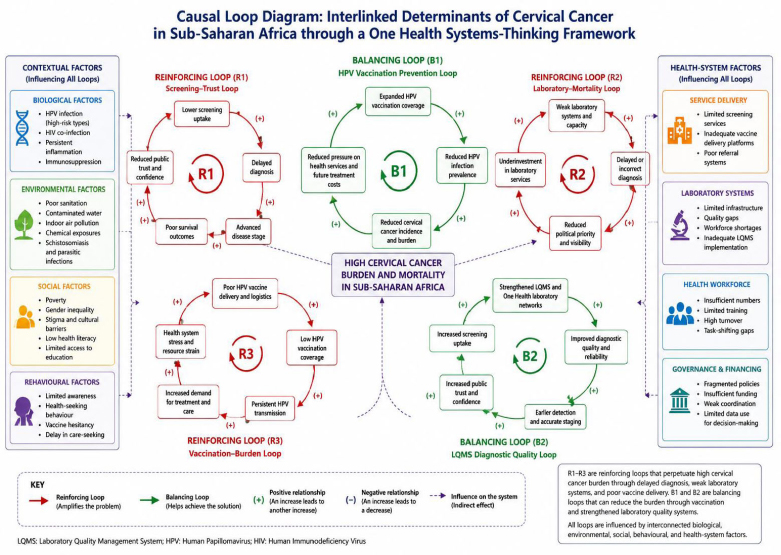
Causal loop diagram illustrating the interlinked determinants of cervical cancer persistence in sub-Saharan Africa through a One Health systems-thinking framework.
- Postponed diagnosis → increased disease burden → overburdened oncology services → poor survival → diminished confidence in health systems → decreased screening uptake.
- Inadequate vaccination delivery methods → inadequate coverage → persistently high incidence → growing need for treatment services → further stress on health systems.
- Social injustices → less access to care and prevention → continuation of health disparities → Women's health is not politically prioritized.
This systems map emphasizes that addressing cervical cancer requires concurrent efforts across multiple levels. If diagnosis, health education, and governance are not strengthened, focusing just on one element (e.g., vaccination) may have limited or unsustainable effects [9, 10].
The diagram shows reinforcing loops (R1–R3) and balancing loops (B1–B2) operating across biological, environmental, social, behavioural, and health-system domains. Reinforcing Loop 1 (R1) demonstrates how low screening uptake contributes to delayed diagnosis, advanced disease, poor survival outcomes, and reduced public trust, thereby further decreasing screening participation. Reinforcing Loop 2 (R2) shows how weak laboratory systems and inadequate diagnostic capacity perpetuate delayed or incorrect diagnoses, increased mortality, reduced political priority, and continued underinvestment in laboratory services. Reinforcing Loop 3 (R3) illustrates how poor HPV vaccine delivery and low vaccination coverage sustain persistent HPV transmission and increase pressure on already fragile health systems. Balancing Loop 1 (B1) demonstrates the effect of expanded HPV vaccination in reducing HPV prevalence and cervical cancer burden, whereas Balancing Loop 2 (B2) shows how strengthening Laboratory Quality Management Systems (LQMS) and One Health laboratory networks can improve diagnostic quality and reliability, facilitate earlier detection, enhance public confidence, increase screening uptake, and ultimately reduce cervical cancer burden. Together, these interacting feedback mechanisms highlight the need for integrated, multisectoral strategies to achieve the World Health Organization cervical cancer elimination targets in sub-Saharan Africa.
5. RECOMMENDATIONS AND POLICY IMPLICATIONS
5.1. Strengthen HPV Vaccination Coverage
- To reach the WHO 90% objective by 2030, national HPV vaccination programmes need to be expanded.
- Implement and scale up the single-dose HPV vaccine, which lowers expenses and logistical complexity [8, 20].
- Use community-based platforms to reach adolescents who are not enrolled in school and integrate immunization delivery into school health programs [21].
- As part of a One Health strategy, make use of current cold-chain networks, such as those utilized in veterinary programs, to enhance vaccine distribution [13].
5.2. Enhance Screening and Diagnostic Capacity
- Switch from VIA to HPV DNA testing, giving point-of-care, reasonably priced molecular tests priority [15, 23].
- Make investments in cytology and pathology workforce training, bolstered by AI-assisted diagnostics and digital pathology [12, 25].
- To guarantee quality and comparability, link One Health laboratory systems with Laboratory Quality Management Systems (LQMS) across national laboratory networks [11, 17].
5.3. Address Social and Environmental Determinants
- Considering the significant co-burden in Africa, combine HIV care with cervical cancer prevention [17].
- To combat stigma, enhance health literacy, and boost screening participation, promote community involvement and education initiatives [27, 28, 31].
- Encourage more studies on environmental exposures, pollution, inadequate sanitation, occupational hazards, and parasite co-infections, as these factors may affect HPV persistence and cervical carcinogenesis through intricate biological and ecological interactions [17, 18, 30].
5.4. Strengthen Governance and Financing
- Create multi-sectoral policies that connect initiatives for HIV prevention, education, environmental health, and reproductive health to the elimination of cervical cancer [22, 29, 31].
- To reduce reliance on donor funding, raise domestic funding for vaccine acquisition, screening, and treatment [2, 6].
- Use integrated health information systems to track and assess progress toward the 90-70-90 eradication targets.
Through integrated One Health initiatives, African nations can enhance health systems, increase efficiency, and hasten the elimination of cervical cancer by utilizing synergies across the environmental, animal, and human health sectors [9, 10, 29].
5.5. Future Research Directions
Future studies should validate the proposed One Health systems-thinking framework in specific sub-Saharan African countries and evaluate its applicability across different health systems. Implementation science studies are needed to determine how HPV vaccination, screening, laboratory strengthening, and community engagement can be effectively integrated into existing healthcare systems [6, 22, 29, 31]. Further research should evaluate the feasibility and cost-effectiveness of point-of-care HPV testing, digital pathology, and AI-assisted diagnostics in settings with limited resources [12, 15, 25]. Additionally, research on the biological impacts of environmental exposures and the function of current One Health laboratory networks in aiding the diagnosis of cervical cancer is necessary [11, 16-18, 30]. Country-specific implementation studies and comparative evaluations across African settings will be particularly valuable for identifying scalable models that can accelerate progress towards the WHO 90-70-90 targets.
CONCLUSION
Cervical cancer is largely preventable and treatable; nevertheless, systemic weaknesses, social inequalities, and inadequate investment in prevention and care continue to affect women across Africa. With HPV vaccination coverage remaining below international targets, limited access to screening, and insufficient diagnostic and treatment capacity, progress towards the WHO 90-70-90 targets remains inadequate. This review applies a One Health systems-thinking approach to show that cervical cancer is a complex systems issue, supported by feedback loops across the biological, environmental, social, and systemic domains, rather than merely a biomedical problem. To break these patterns, integrated measures are necessary, including increasing the use of the single-dose HPV vaccine, fortifying laboratory systems, integrating LQMS into One Health networks, addressing social and environmental causes, and enhancing governance.
It will take coordinated, multisectoral action to eliminate cervical cancer in Africa by 2030. Using a One Health perspective to frame cervical cancer provides a way to enhance health systems more generally and expedite efforts to eliminate the disease. To our knowledge, few studies have applied this narrative synthesis that specifically frames cervical cancer in Africa using a One Health systems-thinking framework. The lessons learned can be applied to other non-communicable diseases with complex determinants.
AUTHORS’ CONTRIBUTIONS
S.A.F.: Conceived and designed the study, developed the One Health analytical framework, performed the literature synthesis, led data interpretation, prepared the figure, and drafted the full manuscript. K.O.: Contributed to the conceptualization, the review of cellular pathology and histopathology aspects, and the critical revision of the manuscript for intellectual content. A.M.: Contributed to data curation, systems-thinking interpretation, and manuscript review. O.J.O: Assisted with literature search, data verification, and editing of the results and discussion sections. I.O.J.: Contributed to the review of African regional screening and vaccination policy data and manuscript refinement. A.C.E.: Supported synthesis of community health and epidemiological perspectives and reviewed sections on social determinants. O.F.A.: Contributed to integration of infectious-disease and environmental-health perspectives within the One Health framework. B.-M.C.O.: Reviewed and refined the systems map and contributed to policy analysis and graphical conceptualization. R.O.O.: Assisted with data verification and review of laboratory-strengthening and LQMS components. P.O.O.: Contributed to critical review of the diagnostic and cellular pathology sections. R.B.O.: Provided input on research design and contributed to the literature review on HPV vaccination uptake. C.E.W.: Reviewed the manuscript for pharmacological and global-health policy perspectives and provided language editing. C.C.N.-U.: Contributed to data interpretation and manuscript editing, particularly within the diagnostic and health-system domains. S.S.: Provided technical input on laboratory systems and contributed to manuscript review and final approval. I.A.UDO.: Provided input on the research design and contributed to the literature review. I.G.O.: Contributed to the critical review of the diagnostic and histopathology sections. All authors critically reviewed, edited, and approved the final version of the manuscript.
LIST OF ABBREVIATIONS
| AI | = Artificial Intelligence |
| AU | = African Union |
| DNA | = Deoxyribonucleic Acid |
| HPV | = Human Papillomavirus |
| HIV | = Human Immunodeficiency Virus |
| LMICs | = Low- and Middle-Income Countries |
| LQMS | = Laboratory Quality Management System |
| NCD | = Non-Communicable Disease |
| SSA | = Sub-Saharan Africa |
| VIA | = Visual Inspection with Acetic Acid |
| WHO | = World Health Organization |
ACKNOWLEDGEMENTS
The authors would like to thank Dr. Jonathan Madukwe of National Hospital Abuja for his insightful advice and helpful criticism throughout the conceptualization of this work. His expertise in laboratory-system strengthening and cervical pathology significantly enhanced the scope and quality of the manuscript.