All published articles of this journal are available on ScienceDirect.

Drones in the Outreach and Accessibility of Healthcare in Remote Areas of Rajasthan, India
 Mamta Patel1
Tanuja Rajial1
Debashis Dutta2
Kuldeep Singh1
Mamta Patel1
Tanuja Rajial1
Debashis Dutta2
Kuldeep Singh1
Authors Info & Affiliations
Abstract
Rajasthan is the largest state in India in terms of land area, and its expansive and diverse landscape complicates the provision of healthcare. There are a lot of rural or remote village inhabitants who are not easily accessible, particularly during times of disasters. Adequate roads and other obstacles usually render the transportation of supplies and collection of diagnostic samples sluggish, resulting in care delays. Today, a new drone technology can deliver medicines, vaccines, diagnostic samples, and emergency supplies in these problematic regions rapidly and safely. In this article, the author(s) discusses the methods in which drones can be used to enhance healthcare in Rajasthan. Drones have the ability to deliver supplies to mothers, newborns, and children within the limited access sources in the region, thus enhancing health outcomes. They also assist the hospitals and clinics in diagnosing and treating tuberculosis faster by providing samples and medications at the right time. Drones can fly over damaged or blocked roads to provide people without access to aid in times of emergency with life-saving supplies. The drone corridor established at Redcliffe Labs, and similar ones in Himachal Pradesh and Uttarakhand, demonstrate that drone-based healthcare logistics may be efficient. Such projects have simplified access to medical care, shortened the time of traveling, and boosted the local economy. With such a technology, Rajasthan will be able to construct a more accessible and sustainable healthcare system, such that even the most remote regions will be afforded quality care. According to the article, drones can be a good alternative to bridging healthcare gaps and enhancing the well-being of the population in remote regions.
1. BACKGROUND
The healthcare system of India is challenged in numerous ways, particularly in remote locations where access to hospital facilities is not always available [1]. People in India live in these areas, which are home to more than 70 percent of the population, and access is even harder. The transportation of patients and medical supplies is vital and can be via land, air, or water [2]. Nonetheless, the conventional approaches are not always effective in remote or underserved communities because of logistical and infrastructure limitations [3]. These problems can be mitigated with the help of drones [4]. They are able to transport medicines and medical supplies as well as test samples faster, cheaper, and safer than cars or trucks. Drone technology is a significant advancement and may transform the delivery of medical supplies in India [5]. World Health Organisation (WHO) indicates that healthcare drone applications can revolutionize healthcare delivery of medical supplies and services, particularly in low and middle-income economies where infrastructure and transport are usually constrained [6]. Drones may assist in delivering medical supplies, responding to disasters, controlling disease outbreaks, and in the distribution of vaccines. They assist in the provision of missing health care links [7].
2. REVIEW OF LITERATURE
Drones render the delivery of goods to inaccessible areas fast and convenient. Drones have revolutionized the healthcare industry in India because they have helped individuals in remote locations to receive medical attention [8, 9]. The application of drones in medical practice will continue to increase rapidly, making the services more convenient and accessible. The medicines and diagnostic samples are usually packed in a container and sent to the location using drones by a cold chain professional who ensures that the temperature of the samples or medicines does not exceed the necessary echelon in case of their destruction. The container is then picked up by the drone and flies along a route that has been planned by pilots at a command centre to deliver it [10]. The drones have been effective, and many companies have begun making use of drones in delivering goods [11]. As of September 2022, 240 drone start-ups in India are concerned with healthcare projects. These emerging business ventures are negotiating more effective methods of conducting tests, supplying medicine, and emergency management [12]. The fact that they were successful indicates that drone-based healthcare logistics is an effective approach and is most likely to continue expanding. The new drone technologies and governmental assistance have assisted healthcare organizations in overcoming problems of access and infrastructure in rural settings. Figure 1 demonstrates some of the applications of drones in the healthcare sector, such as delivering medical supplies, responding to emergencies, transporting samples, planning vaccination, and serving individuals who are far inaccessible to healthcare services.
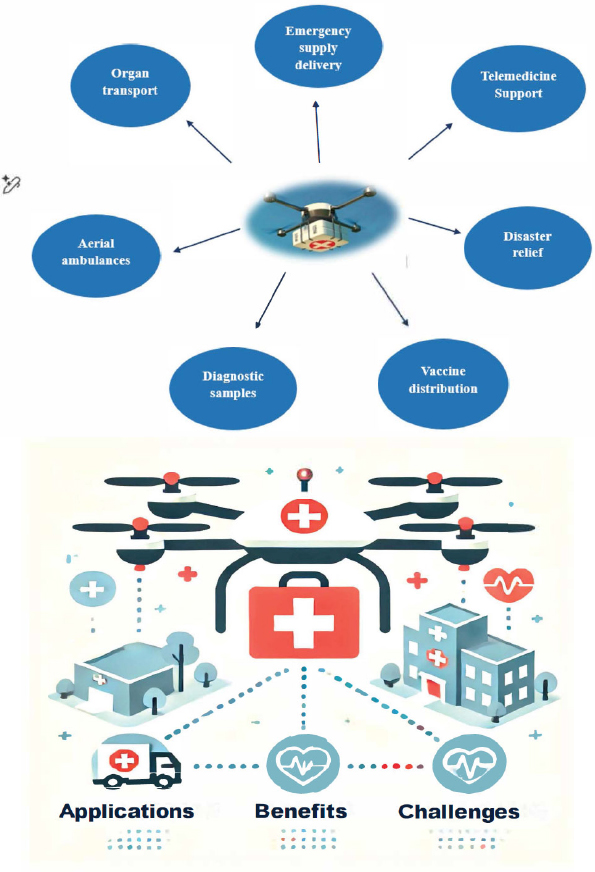
A flow chart of the potential applications of drone technology within the healthcare sector, including some of the top applications of the technology, which are the delivery of medical supplies, emergency response, telemedicine services, and surveillance. The figure also indicates the issues that will occur when it is implemented, such as regulatory, technical, security, and cost issues. Drones can be used to deliver healthcare quickly, effectively, and remotely, but these issues must be resolved to make them ubiquitous and integrated into contemporary healthcare delivery systems.
There is strong policy and financial backing of the Indian government to promote the use of drones in healthcare. Some of the most significant initiatives are the i-DRONE program, led by the Indian Council of Medical Research (ICMR), the Drone Rules 2021, the ₹120 crore Production Linked Incentive (PLI) program to develop drone manufacturers, the integration with Ayushman Bharat, and the plans of establishing drone hubs in 11 All India Institute of Medical Sciences (AIIMS). In the US, India underwent the first commercial healthcare-specific drone flight run by Redcliffe Labs, which is a branch of Redcliffe Lifetech. This undertaking established a drone chamber between Uttarkashi and Dehradun. The drone took only 88 minutes compared to the road distance of 144 km, which took 68 hours or 12 hours in case of landslides [13]. The cargo in these drones will include 5 kilograms of cargo (controlled temperature boxes) and deliver vaccines, COVID-19 test samples, and medical supplies to over 300,000 individuals in eight health facilities within Vikarabad district of Telangana. Himachal Pradesh and Uttarakhand are the other states that have led in the delivery of medical supplies by drone. They have facilitated the delivery of packages to people, minimized the time taken to deliver, and provided employment opportunities within the drone delivery system. More than 519,000 individuals in remote regions in Himachal Pradesh have been assisted by the drones in receiving improved healthcare, despite bad weather conditions and rough terrain. As an example, the deliveries that take 6 or 8 hours between Uttarkashi and Dehradun have been reduced to only 1.5 hours, as a result of drone test flights. This has significantly enhanced the quality of health care in the remote locations.
3. BRIDGING GEOGRAPHIC BARRIERS
Access to the remote and underserved regions is one of the largest challenges of healthcare delivery [14]. A lot of communities, particularly in the developing world, are situated in regions with geographical impediments that make it extremely difficult to access healthcare centers [15]. These issues are some of the problems, such as mountains, thick forests, places that are cut off by rivers, and places that are subject to natural calamities like floods, landslides, or earthquakes. Traditional methods of transportation, such as ambulances or delivery trucks, are not effective or, rather, impossible in such places. Due to this, such groups are not always able to obtain crucial health care services, including vaccines in time, life-saving drugs, or emergency resources, such as blood units.
The solution to these issues has become revolutionary with drones as they can fly across geographical obstacles and access hard-to-reach locations [6]. State-of-the-art drones that can autonomously fly and use GPS control can transport vital medical resources to remote clinics, health workers, or can even fly directly to the patients [12]. As an example, they are capable of keeping the cold chain by transporting refrigerated vaccines using insulated payload boxes. Such capability is particularly valuable in combating diseases, which require immunization of the rural population. Diagnostic samples can also be transported to unreachable locations using drones to the central labs, accelerating the process of testing and diagnosis. This is significant in the management of outbreaks as well as providing people with severe illnesses the care they require immediately [16]. An essential aspect of bridging the healthcare divide between urban and rural regions is the use of drones, since they allow more reliable and quicker deliveries [17]. They also deliver medical supplies in a timely manner to their destinations, and this makes health care professionals respond promptly and significantly enhances health outcomes [18]. As an illustration, when dealing with an emergency such as the birth of a child with complications or cases of trauma, the delivery of blood or other relevant drugs by drones can save the lives [19, 20]. Such a new use of technology is not merely solving the problem of logistics, but it is also transforming the future of equitable healthcare provision [21].
4. EMERGENCY RESPONSE AND DISASTER RELIEF
Speed and efficiency are important in emergency response and disaster relief since these activities may necessitate rapid response in order to save lives and reduce losses [22]. In the regions with disasters and especially during such times, the conventional methods of transport and delivery of aid, like ambulances, helicopters, or ground transport, usually have to be delayed because of damaged infrastructure, heavy traffic, or rough terrain [23]. In such cases, drones offer a radical solution. Drones are able to expeditiously transport crucial medical cargo, e.g. oxygen cylinders, defibrillators, and first-aid kits, as they are able to bypass ground-level obstacles and fly directly to the impacted locations. Their fast deployment will mean that they take a few minutes to reach the needy and save lives or stabilize patients until more advanced medical care is provided, as these life-saving resources can save lives and can stabilize the patients until more advanced medical care is administered. The use of drones with advanced technology, including thermal imaging cameras, can prove to be invaluable in search-and-rescue operations and delivery of supplies [24]. Thermal imaging would enable drones to identify the presence of heat sources like trapped or injured individuals, even in low-visibility conditions because of smoke, fog, or darkness, or in low-visibility environments, such as fallen structures or thick forests [25]. This ability allows rescue crews to find victims faster and more efficiently, and also provides quick and efficient medical care, reducing the overall response times.
Also, drones can operate more effectively in hazardous conditions than standard vehicles [26]. An example is that roads and bridges are often made impassable in case of earthquakes, landslides, or floods, and this severely affects the rescue and relief operations. Nevertheless, drones can easily break these obstacles and deliver supplies to isolated or cut-off populations and become a lifeline in times when other modes of communication do not work [27].
Moreover, the small size and agility of ants allow them to access restricted or impassable areas, including crevices of the mountain or densely populated urban disaster areas. The possibility of drones in the emergency response systems minimizes the loss of life of human responders, but enhances efficiency and speed of the disaster relief efforts [18]. Drones save on the time the rescue teams spend in risky environments since they can deliver their supplies safely and perform reconnaissance by means of drones. The speed, accuracy, and safety of drones mean that they are essential in the current disaster management, as they have transformed the way of dealing with emergencies and saved a number of lives [28].
5. SUPPORTING TELEMEDICINE
Telemedicine may use drones to facilitate the delivery of medical supplies by adding to the virtual model of remote telemedical consultation with the real delivery of medical supplies [29]. Telemedicine has already transformed healthcare, making patients in far-off locations to consult doctors and specialists without the need to travel to the office. However, to ensure that telemedicine is effective, diagnostic equipment, prescriptive drugs, and other valuable health care products should be delivered in a timely manner [30]. Telemedicine services can be made more accessible, complete, and useful with the help of drones. Drones have the ability to send diagnostic equipment directly to people's front doors, including blood pressure meters, glucometers, and test kits for COVID-19, HIV, and diabetes. Through telemedicine systems, patients can take examinations at home and forward the results to their doctors [31]. Such simplified procedures are most applicable in the handling of chronic diseases that demand constant attention and frequent examinations. Use of drones enables doctors to make decisions promptly and be informed since medical supplies reach patients within a shorter period of time. This assists the patients in adhering more to their care plans [32].
Drones could also be used to make sure that the prescribed medications are delivered to patients situated in remote or underserved locations where pharmacies are difficult to locate or access. An example of this is an individual living in a mountainous region or in a disaster-affected region may have to take a long time before obtaining their asthma or high blood pressure drug. With the help of a drone, these much-needed medicines can be delivered very fast, maintaining the treatment process and enhancing health [14]. Drones with payloads that regulate temperature are useful in preserving cold-chain medicines, including insulin and some vaccines, on their way. Another use of drones in the healthcare sector is the ease and speed with which diagnostic samples of patients who are at a distance can be reached by the healthcare providers. As an illustration, a drone can collect blood or urine samples and deliver them to a lab to be tested, thus saving on the amount of time spent in waiting queues [33]. Such prompt exchange of medical data enhances telemedicine services since patients and physicians do not have to wait so long to obtain significant test outcomes. The application of drones in telemedicine is useful in overcoming logistical issues and in making healthcare systems available to the most remote and vulnerable populations. Drones can facilitate telemedicine to make sure that the tools of diagnosis, medications, and samples are transferred without problems between the patients and the providers. This renders telemedicine an appropriate method of ensuring that all people have access to healthcare. Table 1 displays the highest priority of medical drone delivery implementations. It discusses the various applications in which drones can be utilized in healthcare, the advantages they can bring in terms of speed, accessibility, and efficiency, and the challenges that may arise that may make it difficult to use drones, such as technical, regulatory, and environmental factors.
| Application | Use | Benefits | Challenges |
|---|---|---|---|
| Emergency supply delivery | Blood, vaccines, trauma kits to remote/disaster areas | Faster delivery time, lifesaving in critical situations | Payload limits, regulatory approvals |
| Organ transport | Kidney delivery | Preserves organ viability with temperature control | High precision required; limited to small organs |
| Vaccine distribution | Bypass roadblocks (COVID-19 vaccines in Ghana; polio vaccines in Vanuatu) | Maintains cold chain, reaches inaccessible regions | Limitations on battery life in extreme weather |
| Diagnostic samples | TB testing in India | Faster lab results, cost-effective | Sample integrity risks (e.g. temperature) |
| Telemedicine support | Delivery of diagnostic tools (glucose monitors, test kits) to remote clinics for telehealth | Expands access to diagnostics | Requires drone-landing infrastructure |
| Aerial ambulances | Defibrillators, ventilators | Cuts response time | Limited to lightweight equipment; urban airspace congestion |
| Disaster relief | Medical supplies to post-earthquake or pandemic-affected areas | Rapid assessment and delivery in crises | Weather dependency, coordination with ground teams |
6. COST-EFFECTIVENESS AND EFFICIENCY
Some of the main advantages of healthcare logistics using drones include cost-effectiveness and efficiency, particularly in remote or underserved regions. Medical supplies are usually transported via ambulances, trucks, and helicopters, which are very costly because of the fuel costs, maintenance, and labour expenses. Logistical issues like poor roads, heavy traffic, or natural obstacles are also often a constraint to these methods. Conversely, drones represent a highly affordable and efficient solution that alters the financial aspect of medical transport and has made healthcare delivery more sustainable [6].
Drones will reduce the distance covered by cars and trucks traveling to their destinations through uneven surfaces, congested roads, and damaged roads. Not only does this speed allow the delivery of important medical supplies to the destination on time, but it also saves costs. As an illustration, vehicles with shorter transit times consume less energy as compared to those that consume a lot of fuel, which saves money in the long term [34]. The cost-benefit of drones is even more evident in emergencies when time is of the essence, as they can deliver at very low costs and in a short time span the supplies that can save lives. The use of drones also contributes to maintaining a low level of labour expenses, which constitutes a significant portion of healthcare logistics. Plain transportation also involves drivers, support personnel, and in some cases, escorts to guarantee the delivery is safe. Drones, however, may be operated by one pilot or they may be automated. This efficient business operation means that large teams are not required to work, thereby minimizing expenses and salaries.
Besides, drones need less maintenance and infrastructure as compared to cars, which require roads, bridges, or helipads, reducing the overall expenses. These savings have a significant impact in the areas where resources are scarce and healthcare budgets are constrained. The use of drones enables healthcare systems to use their money more wisely by targeting their finances on improved patient care, increased services, and preventative health initiatives. Drones can bridge the healthcare gap by providing reliable delivery of medical supplies to even the most remote parts of the community. This can be achieved since they reduce the cost of logistics [35].
In arid regions such as the deserts of Rajasthan, sand particles cause much faster wear on vehicles and consequently ground ambulances are costly to operate. Owing to this, the average ground ambulance is estimated to cost between INR 300-500 per kilometre to run, 20-30 per cent higher than the normal ambulance since it consumes more fuel and needs higher maintenance. Conversely, drones are less expensive to operate, approximately INR 140-180 per kilometre, since the electric driving systems are not highly influenced by particles and do not require extensive maintenance except for the replacement of the battery occasionally [36].
Moreover, the drones enable the supply chain to be managed more effectively as delays or issues are minimized. Poor weather, road blockages, and scarcity of fuel are only some of the issues that may befall the traditional supply chains. Such issues may lead to severe medical supply shortages. Drones, in their turn, do not need to contend with these issues, which means that valuable goods can be delivered to their destinations without complications. This reliability makes it yield improved patient outcomes and reduced costs due to stockouts, waste, and emergency interventions. Concisely, drones represent an initiative that will revolutionize the logistics of healthcare due to their high efficiency and low costs [4]. Drones assist healthcare organizations to provide the necessary services at a cheaper and more sustainable cost through cutting down transportation period, decreasing labour expenses, and avoiding supply chain interruptions. The new concept is particularly significant to the areas where resources are scarce, and all the savings can be allocated to healthcare and even save more lives. Table 2 displays numerous applications of drones in the field of healthcare and includes emergency deliveries, diagnostics, rural accessibility, and disaster response. It talks about the government programs, pilot projects in the region, hurdles of adoption, how success can be measured, and the future of scaling up the drone-based healthcare services in India.
| Category | Details | Examples/Projects |
|---|---|---|
| Key Applications | Emergency medical deliveries (blood, vaccines); Organ transport; Rural healthcare; Disaster response; Diagnostic sample transport | 35 km in 15 mins (ICMR Delhi-NCR trial), 80% faster than road transport; AIIMS Rishikesh pilot: drone-based organ delivery |
| Regional Projects | Demonstration projects across states | Rajasthan: DREAM Care (AIIMS Jodhpur); i-DRONE Program (ICMR Northeastern States): vaccine delivery; Himachal: TB sample transport, 67% faster delivery; Telangana: Medicine from Sky (serving tribal areas) |
| Government Support | Policies at the national level that promote drone use in healthcare | i-DRONE program (ICMR), Drone Rules 2021, PLI scheme, ₹120 crore for manufacturers, Ayushman Bharat integration, and a plan for 11 AIIMS drone hubs |
| Challenges | Barriers to wider adoption | Dependence on the weather; delays in getting BVLOS (Beyond Visual Line of Sight) approval; Restrictions on airspace; limited cold chain in rural areas; Not many people in the community know about it: only 57% in NE states. |
| Success Metrics | Results that can be measured from pilot projects | 50-80% faster deliveries; 67% lower vaccine wastage; 25% cost savings (Himachal TB program) |
| Future Outlook | Emerging opportunities and growth trends | AI-powered navigation; Hybrid drones; Community training and Drone Didi self-help group initiatives; Cold-chain expansion; $1.9B market projection by 2032 |
7. CHALLENGES AND THE WAY FORWARD
There is great potential of drones in healthcare, and there are a few issues that need to be overcome before the potential can be fully realized. Approximately 30,000 primary healthcare centres are operated by the Indian government, although 5-10 percent of them remain inaccessible because of either the geographical position or other natural calamities. Drones have already demonstrated that they are capable of delivering healthcare supplies and diagnostics to such locations. Last-mile delivery is a significant problem in developing countries. The reason is that medical supplies are mostly damaged, lost, or delayed during their transportation to distant localities. The issue has been aggravated by the COVID-19 pandemic, and the significance of new technologies, including drones, is emphasized to boost access to healthcare and ensure strong chains of medical supplies. This is extremely significant in the medical sector when it comes to delivering on time and at the appropriate temperature. Most hospitals and clinics do not have devices to conduct diagnostic tests, and thus, the samples should be forwarded to central labs. Certain diagnostic tests are so quick to have to process the samples in a very short period, and in some cases, it can be as short as 2 hours. The solution is the drones since they guarantee the prompt delivery of packages and the maintenance of constant temperature in the packages. They are able to transport medical supplies and diagnostic samples in remote locations and over extended hospital campuses swiftly and dependably, significantly accelerating the supply chain. This is an invaluable skill during emergencies or when other usual methods of delivery fail to produce good results.
Furthermore, drones are also making the operations less expensive and more efficient. They require fewer individuals to work on their jobs, and they will never fail to do them on time. The use of temperature-controlled payloads guarantees that medical supplies are of high quality and safety, even during difficult deliveries. Drones also carry diagnostic samples in large healthcare campuses, accelerating the processing process and streamlining the healthcare delivery system overall [37]. Improved supply chain management can not only assist healthcare providers in serving their patients more effectively, but also enable them to expand their business and gain more customers.
Although these are positive issues, there are some major issues that will make it difficult to have drones widely used in healthcare. The regulatory limitations are also a significant problem since most nations, and India is not an exception, are still working on developing an elaborate set of regulations regarding drones in healthcare. The short battery life and payload may restrain the range and size of drones, particularly when transporting items over a long distance. Moreover, the necessity to have qualified personnel to control drones and keep their systems operational complicates the situation further. Safety and privacy of information are another major concern, particularly when drones are delivering sensitive medical supplies or information.
Governments, healthcare providers, and technology developers must collaborate in order to address these issues. The initial move is to develop specific rules concerning healthcare applications. The research and development may be improved to enhance the drone technology in terms of longer battery life and higher payload. The training programs may assist in developing a skilled workforce that will be able to operate and maintain the drones. Pilot programs and partnering with the industry can show how drones might be applied to healthcare systems and how they may enhance access, efficiency, and cost-effectiveness.
The summer temperatures in Rajasthan may exceed 45 C, thus reducing the battery life by 20-40%. This would decrease flight time by a factor of two, 20-30 minutes down to 10-15 minutes, and increase the chances of thermal stress. An active cooling system should be used to keep the temperature of the battery below its typical overheating level when outside conditions are hot. At a temperature greater than 40 °C, passive insulation is not suitable enough to handle temperature-sensitive payloads like vaccines and blood products. Rather, it requires insulated compartments with dry ice or thermoelectric cooling, which have been tested in hot climates. It can further be enhanced by operational interventions like early-morning or late-night flights, and a charged infrastructure that is shaded, thereby making it even more possible during extreme heat [17].
Drones also have the potential to transform the healthcare delivery system by ensuring that even the remotest and underserved communities can receive high-quality medical services within a short time. The anticipated advantages of the introduction of drones into healthcare systems, including the improvement of health results, cost reduction, and equitable service delivery, demonstrate the significance of pursuing the use of this technology. Nevertheless, the effective implementation requires the combination of technology, policy, and healthcare sectors.
8. CURRENT USAGE OF DRONES IN HEALTHCARE
In numerous significant ways, drones are increasingly finding applications in enhancing healthcare delivery. They facilitate faster transportation of medical supplies, emergency medical services, and rescue efforts, more so in remote or disaster-prone regions where normal transport is difficult [38]. There are also drones that are employed to ferry test samples (blood and other biological samples) between healthcare facilities in the shortest time possible. This will make sure that there is timely diagnosis and treatment. The researchers are further investigating the use of the technology in organ transfer that would accelerate donor organ transfer to transplant, thus significantly enhancing transplant rates [39]. Drones are not only useful in logistics, but also they are also used to facilitate remote surveillance and 24-hour monitoring of healthcare services, hence enhancing the management of healthcare delivery in remote locations [40]. They are also involved in telehealth and tele-education through offering health consultation and medical training to individuals who cannot access these services. Drones are also utilized in campaigns to create awareness and sensitivity regarding the aspect of infection control, which urges people living in remote locations to adopt preventative measures [41]. These applications demonstrate how drone technology is transforming the healthcare sector of by making it more convenient to reach, efficient, and healthier during challenging scenarios.
9. WHY DO HEALTH SERVICES IN RAJASTHAN NEED DRONE SERVICES?
Rajasthan is the largest state of India in terms of area, as it occupies an area of 3,42,239 square kilometres and a population of approximately 6.86 crores. The geographical and diverse nature of the population in the state complicate healthcare provision. A majority of the population of the country (three-fourths of the population) resides in more than 44,672 villages and predominantly in rural regions, so access to timely medical care is a significant issue. Outreach is further complicated by the various forms of land in the state, such as plains, deserts, and mountains. This is particularly so in remote village locations in deserts and mountains, which are hard to reach during an emergency of health or natural disasters. The technological innovation of drones is a game-changer that could assist in delivering healthcare services directly to the homes of those who are vulnerable and underserved. Drones can be used to bridge the gap between hospitals and the rural communities that require their services most in Rajasthan. They are able to deliver medical supplies, vaccines, diagnostic samples, and life saving drugs where there are no normal means of delivering them to the location, which is too slow, too costly, or even impossible to do so. It is particularly necessary to address the healthcare needs of the population in hard-to-reach locations or those who may be affected by disasters. Potential implications of the use of drones in the healthcare system of Rajasthan involve important areas of healthcare. Drones would also be useful to minimize maternal and infant mortality rates since priority drugs, vaccinations, and nutritional supplements can be delivered on schedule. Drones can transport vital items to hard to reach locations, including vaccinations against preventable diseases, which will contribute to the higher immunization rates in children and adolescents. Drones will be able to accelerate the delivery of diagnostic samples to central laboratories and medications directly to patients with chronic communicable illnesses such as tuberculosis. This ensures that there is no cessation of treatment.
Emerging medical services can also be very useful with the help of drone technology. Drones may be used to deliver emergency supplies, including oxygen cylinders, blood units, and first-aid kits, during acute health emergencies, including during natural disasters when roads become blocked or infrastructure is damaged. Drones may also be a savior for individuals in regions where subacute and chronic medical issues do not have or do not have enough healthcare providers. Drones have the potential to contribute to the improvement of the health rates of the underserved populations in Rajasthan by making sure that the needed resources are moving in the shortest time possible and at minimum costs. This can be used to compensate for the deficiency of the healthcare infrastructure. Moreover, the application of drones can fit the resource-constrained area of Rajasthan because it requires cost-efficient solutions. The drones assist healthcare in accessing people faster and more cheaply by lowering the transportation costs and delays. They also have the ability to be scaled, which allows the healthcare providers to have access to areas that were hitherto inaccessible.
Finally, drone services are an emerging technology that will transform healthcare accessibility in Rajasthan. They are needed in equitable healthcare since they are able to perform in any weather type, deliver services promptly and affordably, and address the urgent, subacute, and chronic medical requirements. The drone technology can help Rajasthan to solve its own problems and make sure that even the farthest corners of the world can obtain the medical treatment they require.
10. PLAN HOW TO USE DRONES IN THE AREA OF OPERATION
An all-encompassing plan of executing the drone technology in Rajasthan health care is a multistep process, which entails a few key steps. First, it needs to identify and determine the right area. As an example, the highlands of the Sirohi district with the tribal communities and the dry villages of the Jaisalmer district are given priority because of the inability of the residents to receive proper services. The identification of a clear take-off point (Point A) and a landing point (Point B) makes the medics and medical supplies safe [42].
In selecting a drone, you have to think of how you will employ it, its range, carrying capacity, and the nature of the terrain it will be working on. The drones will be used to carry out different functions such as the delivery of medication and the collection of diagnostic samples. Set-covering methods are used in order to find the minimum number of drone centres that are required to conduct optimal operations. These are then used in the multi-depot vehicle routing models, which make sure that samples are delivered in a timely manner without high costs.
The other key component is meticulously arranging the routes of the drones and selecting safe and easy places to take off and land. To make it safer to use, it is possible to create a Keyhole Markup Language (KML) file of certain routes and make sure that the necessary Air Traffic Control permissions are provided to meet the laws of aviation. Such an approach allows visualising geospatial information and automatically planning routes. An almost straight line between Sirohi District Hospital and any Basti depicts terrain-conscious way point planning. The corridor does not use restricted or culturally important regions, it consumes 15 percent less energy, and it transmits KML files to drone flight controllers, which can then be used within the PHC network in Rajasthan.
Training programs underscore the significance of educating health workers at the start of their training and the end of their training. That will guarantee that they are qualified to fly drones safely and in a manner that complies with the set regulations. Quality control is provided to make sure that carrier boxes that are used in transporting medicines and diagnostic kits retain the safety and integrity of their contents during the shipping process.
In order to overcome the hurdles of little community awareness and resistance, collaboration between tribal leaders in the districts, like the Sirohi district, is advised in a four-stage strategy. It involves engaging community members by organising village demonstrations, co-ownership by Tribal Drone Advisory Councils, capacity building by training local youth as drone-mitras, and continuous feedback by local helplines and panchayat reviews.
Last but not least, the application of drones in healthcare is monitored and evaluated to recognize and mitigate challenges as they become apparent, thus leading to the consistent advancement of service delivery and patient outcomes. This systematic process made it possible to successfully incorporate drone technology into the healthcare delivery system of Rajasthan and especially to the remote communities that receive poor healthcare services. One of the major limitations of this conceptual review is that it lacks the actual data of flight in the Thar Desert in Rajasthan. The experiences of Himalayan drone pilots formulate the operational assumptions, but these do not include the numerous difficulties associated with working in desert conditions. The problems of sand abrasion and dust ingress, and the further effect they have on the work of drones and their maintenance over time, are not sufficiently discussed.
CONCLUSION
Drones are a revolutionary solution to enhancing the accessibility and delivery of healthcare services, especially in isolated areas that experience difficulties with receiving proper medical care. This is a new technology that breaks geographical barriers, improves emergency response efforts, supports telemedicine programs, and is a cost-effective way of providing medical supplies to people. Drones will become an even more important tool in improving equity and efficiency within healthcare systems as drone technology advances and issues related to its operation are resolved. Over the past few years, drones have emerged as a game-changing experience in various sectors, including the healthcare sector. Drones have become one of the greatest innovations in modern healthcare delivery because they can go over rough areas, make sure that the necessary medical supplies reach the target areas in time, and provide people in remote places with an opportunity to receive healthcare services. To determine the performance of drones, such as sand abrasion, thermal battery degradation, and payload stability, future studies are necessary in the Thar Desert to utilize the prospective studies. To assess cost-effectiveness, health outcomes, and related results, longitudinal studies are required.
AUTHORS’ CONTRIBUTIONS
The authors confirm their contributions to the paper as follows: A.K.M., M.P. and T.R.: Study conception and design; A.K.M., M.P., and T.R.: The literature review was conducted; K.S. and D.D.: The first draft was written, and the figures were prepared by the authors. read and proofread the article; K.S.: Developed the theme, determined the headings and subheadings, and gave a final review of the manuscript. The results were reviewed by all the authors, and the final manuscript version was accepted.
LIST OF ABBREVIATIONS
| AI | = Artificial Intelligence |
| BVLOS | = Beyond Visual Line of Sight |
| GPS | = Global Positioning System |
| KML | = Keyhole Markup Language |
| PHC | = Primary Health Centre |
| PLI | = Production Linked Incentive |
| UAV | = Unmanned Aerial Vehicle |
| WHO | = World Health Organization |
ACKNOWLEDGEMENTS
The authors sincerely acknowledge the generous support of the Health Technology Assessment in India (HTAIn), Department of Health Research (DHR), and the All India Institute of Medical Sciences (AIIMS), Jodhpur, India.